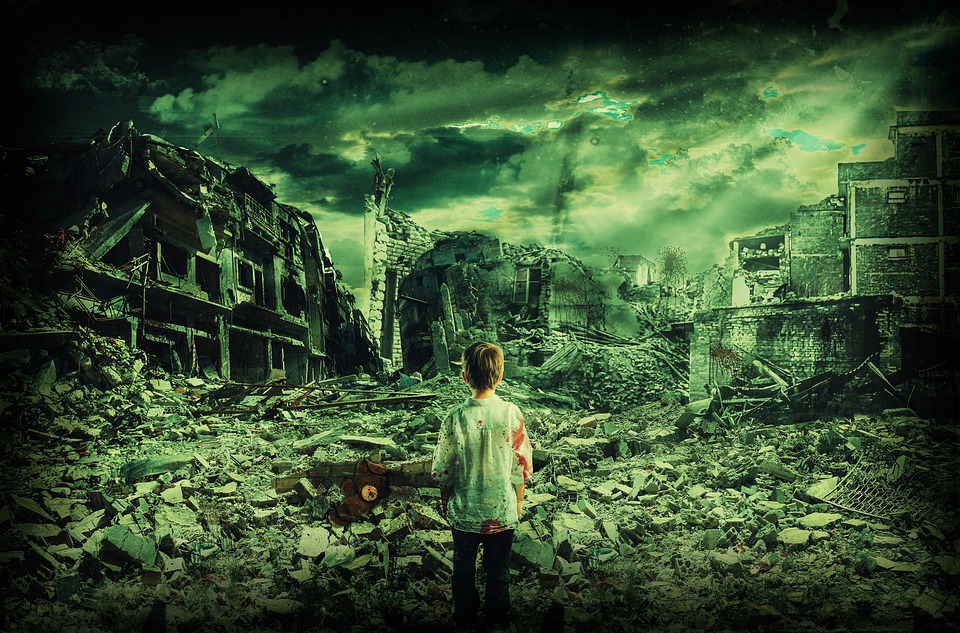
When your Home is at War and The World is Against You, How can Families Remain Resilient?

Conflict is one of the most monstrous catalysts for catastrophic poverty. Absolute poverty for an entire population. A country afflicted with conflict is a government pulled away from its main duty to govern and lead its nation toward an enriching landscape for development and sustainable happiness. Instead, it is distracted by the vicious and violent chaos that has arisen. Most often, these players of power bite back, and with even greater chaos.

Between everything, lies the general population. They do the best they can, desperately scrabbling some form of sustainable living for themselves and their families. The human necessities of shelter, healthcare, food and even water can be stolen away by conflict. With climatic pressures of natural disasters, especially drought, families and millions of children are stranded in a barren yet hostile landscape of nothingness, except destruction. Food insecurity and death by starvation is rocketing upwards on a dramatic scale, and famine alerts have erupted in each zone of conflict.

In this current time period, there are four too many areas of significantly widespread conflict: South Sudan, Yemen, Northeast Nigeria and Somalia. Tens of millions of people have been affected; internally displaced people (IDPs) from their regular lives, thrust into a mad world by powers completely out of their control. It is a completely avoidable humanitarian crisis born from corruption plaguing the ruling parties..

The governments of these countries tend to be uncaring, with some blaming the insurgents for the conflict, shoving away any responsibility peaceful governments naturally accept. With their growing abrasive attitude toward the International Humanitarian Law, the world grows more and more violent, making our Earth a more dangerous place to live within.  

It is crucial that in moments of conflict the general population are able to remain resilient. After all, without resilience there cannot be a productive population; only one that gradually wastes away. Farmers and producers are most likely to be hit. Battles obliterate any chance for peaceful production of agricultural or manufacturing items.

Households relying on farm produce to feed families found their tools lost or stolen as a result of the Boko Haram insurgency in the North East of Nigeria, adding to the 250,000 Internally Displaced Persons as they go about trying to find alternative means to feed their families. In many of the countries of conflict, as a result of the reduced production levels, prices rise whilst supply restricts. The cost of sustainable living becomes higher and higher as the war toll roves on. In Somalia, the price of vegetables such as legumes has doubled since the outbreak of war. Food is so scarce it has become unaffordable. Farmers, producers and the rest of the population all struggle to find sustenance in this catastrophic time.

With higher food prices, more and more families are forced to give away their health and education to save as much money as they possibly can whilst trying to earn as much money as they possibly can. With less money to spend on medicine, individuals are more exposed to disease. At the same time, children and adolescents are more exposed to the necessities of child labour rather than undergoing an enlightening and empowering education.

More and more are being forced to join the violence, to fight for resources. The Boko Haram insurgency especially recruiboy-509488_960_720ts with a rhetoric of a plenty, promising new initiates a rich and bountiful land to reap their livelihood from. It has meant that communities from this region are treated with great suspicion when they try and settle elsewhere in Nigeria, and have consequently been isolated. 5.1 million people struggle with little or no social support .  It’s as if they are carrying the violence like a disease. When the world is against you and abandons you outside, how can a household cope?
The immediate answer is humanitarian aid: funding from richer countries to help support humanitarian workers reach these stranded families and give them a safety net from death and malnutrition.

However, in many cases, the budget demanded by UN freedom fighters comes short. $439 million was given toward the humanitarian fight to help displaced peoples coping with the barbaric conflict in South Sudan, which is amazing. But is only a quarter of the $1.6bn necessary. To make matters even more costly, insurgents often block foreign aid to make the trapped population more dependent upon insurgent control.

In the case of Somalia, the Al-Shabaab have attempted to provide their own form of aid, and attack any attempts from outside to provide support. Yet with half the population facing hunger and death, their attempts were not fully successful, clearly.

Sometimes, such as South Sudan, 82 humanitarian aid workers have been killed in their ventures to assist the weak. This not only lowers the humanitarian army immediately, but increases the risk, disincentivizing others from joining movements. The risk factor increases the starvation and 40% of the population are food insecure.

Most of these regions have peacekeeping bases for IDPs. But while ‘peace’ may be an adjective to describe the refuge camps, they are still places of death.

The peace communities in Northeast Nigeria have extremely poor living conditions, with 19% of children existing with acute malnutrition. Huddled into a random town with little means for sustenance and the risk of disease in every direction, the likelihood of generating a sustainable income or flow of resources into families is very small.

What’s more, “camp elders” exist and exploit family members because of their lack of options. Women are raped, children are abused and men are beaten. To keep these people helpless, the elders are there to block humanitarian aid that seeks to aid and assist, further isolating the IDP populations.

Conflict is unavoidably destructive. The populations of these countries caught in the crossfire of explosive civil war will almost always be adversely affected. Whilst the intentions of Humanitarian Freedom Fighters and support from the Western World is to relieve the hardship and suffering, and hold a lot of power in doing so, the ruling government of each region has the power to avert these attempts, and even massacre those who try to give gentle kindness to a mass field of suffering on the proportion of tens of millions. 17 million are facing famine and destruction in Yemen after all. There is no easy answer to these millions, when the resources to help empower themselves, particularly to women, are pushed far out of reach.  
sad-1973424_960_720

It’s possible that if power was more localized, then the population who benefit from such amenities would be those who make decisions, yet that would leave the positions of high power in positions of far less power. Centralized government is far more effective when corruption is low. With high corruption in the bureaucratic halls of the larger cities, it is highly implausible for an experiment such as this to be made. If only there was an avenue through the gunfire to progress. Humanitarian workers are continually fighting for this, and routes through to give aid. Only some are successful.


Running: My Guide to The Puter Footer in Fronter the Other One…er

Running looks so simple, doesn’t it? We see people all the time gliding across our local parks like gazelles, leaping through the undergrowth and voyaging to wherever their heart’s desire takes them. It seems so easy to copy, replicate and increase.

Sometimes a skill can seem so simplistic that even a sloth who has sat in a tree all day, eating bananas and talking to pigeons lurking on the nearby electric pole line could do it. We only seem to see the act itself. We hardly ever see the practice, repetition and pure dedication involved. The heavy streams of sweat and tears, the long grinding motivation and the deep painful climb are beyond us.. The final product is a facade of its making. But still, we make interpretations and say “I can do that. I’ll do that tomorrow morning. It’ll be easy”.

Like with running, the first time a person goes for a run in their lives. The first few steps are awesome. Like, wow, isn’t this fun? Your body going up and down, peddling along the street, happily in your own bubble of tranquillity. But then, all of a sudden, just at the moment you feel like you could tickle the wing of a butterfly, PAIN hits like a bullet in the chest. It seers down into your abdomen, landing heavily and abruptly in your quadriceps and calf muscles, torturing your body with spasms and pinpricks. Your lungs heave up and down, making lame hefty attempts to hoist the pain out of the stomach and over the nearby fence. But to no avail. Eventually, most people end up slumped against a wall, wondering what beauty ever actually existed in the world and questioning the meaning of life.

At least, that’s what I think happens.

If you have hardly ever gone on a run in your life and want some advice, you can do it. That’s just encouragement. Don’t give up on running. Running is tough to begin with, and you should never underestimate it. If your leg muscles aren’t adapted to the fast pace of running, then intense repetition for a long period of time could lead to muscle damage which usually takes weeks to recover from. You need to put your toe into the water to check the conditions of the pool before you dive in. I’m still talking about running, not swimming. (Although I’ve heard swimming is cool).

I was quite nervous in telling you that because I do not want to discourage you from running by overly scaring you through my occasional hyperbolic writing style . I just want you to be careful with yourself. When I began running again after four months of inactivity – staring at a wall, and saying ‘goo goo gaga’ a foot injury halted my reintroduction to running pretty quickly. That was because I was going on runs an hour long, downhill and on hard tarmac. Basically I was giving my feet the beating of its life! I was basically shoving Peppa Pig into a boxing ring to beat up Mohammed Ali. I wonder who won? (Not Peppa Pig, in case you were wondering. But wouldn’t it be amazing if she did? Go piggy!).

Ideally, your first run should be on softer ground. Go to a field, any field. Preferably a meadow, farmland has harder ground from constant plantation of soils. Or go to your local common or forest where there are soft ground pathways. Plus off-road running is much more pleasurable in my opinion than road running where you have gigantic beast machines hurling past with their gigantic plumes of exhaust fumes which you suck up like an 8 year old child avidly drinking Coca-Cola.

Time? Hmm, three hours! I’m joking. That’s crazy, unless you’re like… superhuman. Are you? Well, if you’re not, for the first run I would recommend ten minutes. For some, that may be absolutely miniscule, smaller than a mouse whose toes have been chopped off. But seriously, ten minutes will feel like a long time on a first run. That’s longer than the time it takes to stagger around the 1500 metres in school. You’ll probably run 2K in that time, unless you collapse from exhaustion and dehydration and wake up at the bright lights (big city) of the hospital. I’m really not good at encouragement… but upon conquering the 10 minute body massacre, you can move up to 11 minutes, and then 12… and then… yeah, you know. Just steadily increase the time until you reach a length of running amount you are satisfied with. I don’t know what your intentions are with running, but most are to stay fit and lose weight. So, to do that, reach a 30-40 minute run is a healthy habit to maintain… which is about 8 kilometres.

Drink enough water – not too much or water you’ll be waterlogged; sloshing great oceans of water inside you as your trundle along your first steps. Just drink a glass, and if you are going for a long run, maybe bring a bottle (water, not alcohol) with you, especially if it’s a hot day. Running whilst dehydrated is the worst – headaches, nausea, dizziness… Gosh running sounds fun, right?

Don’t get lost. Once, I decided to explore my local area. I ended on a Police Dog Training Ground. Never again. Be boring and remain on the ground you know and love. Nah, just bring a map and be careful. Have fun exploring. Some of the best runs of my life have been when I just let myself run along a completely new trail, blazing new landscapes and completely benevolent views, crisply cutting through the sides of hills and floating through valleys of gently flowing streams and soft singing birds. I’m not even exaggerating. Somehow, it happens. But then again, I’ve also had some of the worst. It’s a gamble, but if you strike gold, you will receive an ocean.

I really hope you have an amazing time on your runs though. The first few are tricky, and may leave your body screaming at you worse than a tantrumous child. But after that, you really land into a beautiful routine – one which you can really appreciate. Running provides such amazing benefits which are quite invisible when observed from afar. It just seems like putting one foot in front of the other, really fast. But it’s so much more. Fitness, motivation, energy and love. There are acres upon acres of possibility with running, and that’s not just geographical. Have the greatest of times upon your cardio adventure!

Microfinance: Obliterating Poverty for All Those Who Want to Fly?

Microfinance has made a strong impact upon many people’s lives all across the world. More than a hundred million families have been touched by the opportunity for acquiring small yet powerful loans that can provide stepping stones and climbing frames to haul themselves out of the poverty trap cycle.

Left to its own devices, poverty breeds poverty. Families do not have the funds to fully acquire healthy nutritious food, books for school, transport to work and many other luxuries that the First World takes for granted. Families suffer from their disadvantages and, of course, this means that children from poorer families are disadvantaged compared to the children from richer families who are given the tools to thrive.

The cycle of poverty and poverty oppression has existed for hundreds of years. However, now, there is hope. Banks have emerged. And with banks, so has credit and loans. Of course though, the first few banks would not dare to go near anyone with even a hint of impoverishment and due to negative social sentiments towards women at the time, women tended to be denied from these banks as well. They believed that poor people would never ever pay back their loans as they were too poor to do so, that they will just take the money and run for the hills, laughing ecstatically and demonically over the easy trickery they caused over the innocent and trusting banks.

One economist, Muhammad Yunus, realized that this idea was obviously false, and only existed in the minds of traditional and rich bank owners due to their lack of exposure and contact to poorer people. There really was a sense that the ‘rich’ and the ‘poor’ were two separate species, and had their own characteristics and features, and this only sought to heighten discrimination and neglect to the poor from governments, filled to the brim with ‘rich’ men.

After a world-changing and enlightening conversation with a remarkable 21-year old woman selling trinkets in the local market, Yunus realized that action must be made to lift those similar to the woman he met and millions more out of the gutter and into leadership management positions inside enterprises and businesses that they built from scratch. Thus, Yunus created a new breed of bank – a microfinance institution, the Grameen National Bank. This bank’s primary aim was upon handing small and tiny loans to people dulled by the weight of poverty but lit by the fire of ambition for a better life for themselves, their friends and, most importantly, their family.

These loans allowed people with no alternative funds whatsoever to grab hold of machinery such as sewing machines to create clothing or goats to produce milk. Without the loan, they would have never had the funds to purchase these items. Some individuals purchased items in large quantities at stock prices and then sold the item at smaller individual prices. For example, milk powder.

As a consequence of the microcredit then, small enterprises were created and thus profits were generated. These profits could be used to pay back the loan. Further future profits then would be able to continue to sustain the business into the indefinite future and thus allowing the enterprise to lift its owners out of poverty. With good and successful growth, the business owner could then hire others to work for them and build the product. This then creates jobs for the community, lowering unemployment and giving the poor the power to not only provide food, medicine and supplies, but also maybe a toy for their young child or a day having fun in a recreational activity.

Once the loan is paid back, this gives the opportunity for Grameen National Bank to give that loan to another individual who can then begin their enterprise. This begins an eternal cycle that has a domino effect of knocking the disadvantages away one by one to all those within the poverty line who want to succeed and be leaders in the industry that they sell inside.

Ever since the first microfinance bank in Bangladesh, microfinance institutions have tended to see extremely high payback rates, completely contradicting incumbent bank sentiments at the time. The pay back rate was so high not only because individuals felt an inherent necessity to be honest and law-abiding in their actions, but also through the particular system enforced from the beginning of creation. Borrowers from each community were clustered into groups. The microfinance bank would tell them that if at least one of the group did not pay back a loan, then no borrower from the group were able to take out another loan. This created a sense of social responsibility and inflicted great social shame to the borrower who did not pay back. As a result, individuals felt a much more compelling need to pay back than if they were paying for themselves. They are not just paying for themselves, they are returning the loans for other people whom they have a natural care for as well. Even the poorest of us feel compassion for our friends and neighbours.

Nowadays, there are hundreds of different microfinance banks catering to millions of impoverished people across the world. 93% of the beneficiaries are poor women. In poorer countries, women are far more likely to be stuck in poverty than men. This is because of their burden of childcare and also because patriarchal societies sometimes still exist in these areas, enhancing false sentiments that women are less effective and powerful than men.

Microfinance seems a tried and proven method for escaping poverty. Without the helping hand to establish themselves in the market, impoverished people would be stuck scrappling for some kind of stability in a chaotic and unstable environment filled with temporary employment and exploitation. Microenterprises offer a stable income, the ability to send their children to school, to pay for the medicine to feed their sick relative suffering with AIDs, and to be an individual who can help out in desperate situations. Microfinance provides the tools to not only build new products and livelihoods, but also for the community to support itself and live happier and more exciting lives.

Who knows, in the future, the children of microbusiness owners could flourish into powerfully capable individuals thanks to the education and wellbeing given by the microfinance. The effect of microfinance has only been in existence for a few decades. Think of the evolution and butterfly effects those tiny little loans could have. One small loan can cast a gigantic shadow.

Above I have mentioned the rosy perfect picture of microfinance: alleviating poverty and with the power to spread across the world. But, microfinance has its limitations and its simplicity is a dangerous idea. Its ability to capture the fondness of wealthy foreign donors and its charm of providing disadvantaged individuals with the grappling hooks to hinge themselves away from chaotic instability of a poverty lifestyle can often mean that the positives and advantages of microcredit is emphasized and perilously exaggerated. After all, doesn’t what I just described sound so perfect and amazing? Poor people can do everything for themselves, and their lives will be happy and fulfilled! Yay. But is the outcome of microfinance for individuals always a ‘yay’ instead of a nay though?